Materials
Zirconia or acrylic: the decision that moves your bill most
Most people choose their bridge material by accident, as a line item on a quote. On a two-arch case it is often a five-figure swing.
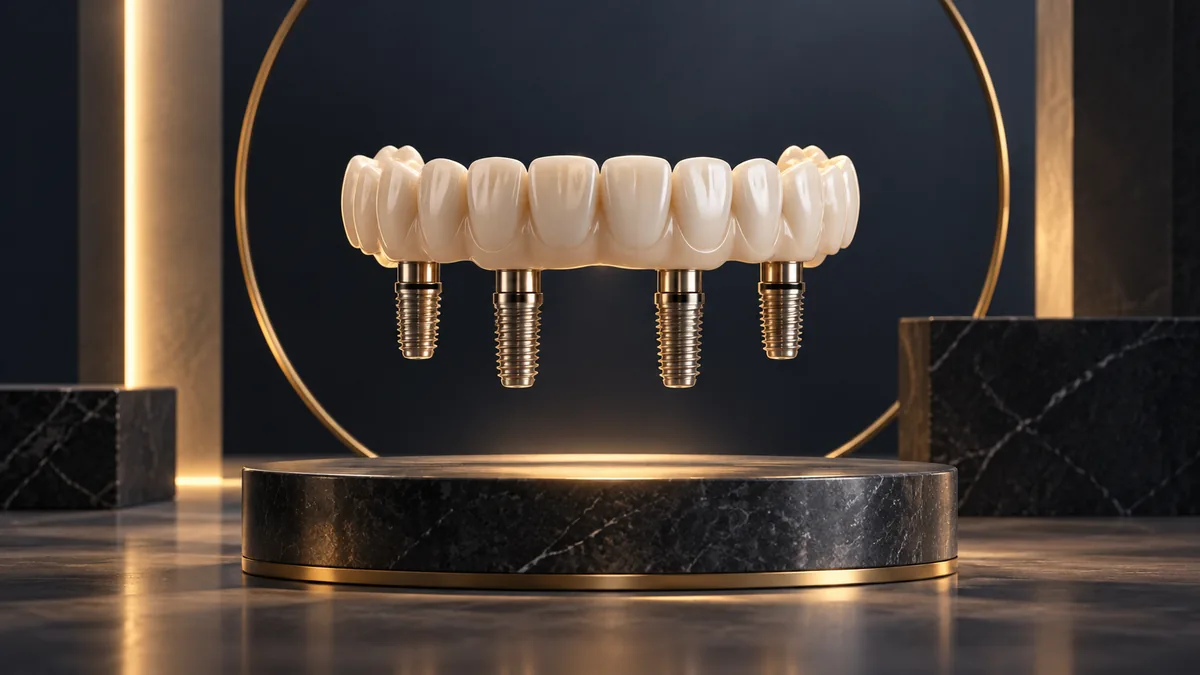
Most patients choose their bridge material by accident. It arrives as a line on a quote, or as the difference between the “standard” and “premium” package, and by then the decision has been made for them.
It deserves better attention than that, because on a two-arch case it is frequently a five-figure swing — more than the difference between countries.
The two real contenders
Acrylic hybrid on a titanium bar
Denture-grade acrylic teeth and pink gum material processed around a milled titanium substructure. It is the original All-on-4 prosthesis and it is still the most commonly delivered one worldwide.
In its favour: it is the entry price tier everywhere. It has slight shock absorption, which some surgeons argue protects the implants. And critically, it is repairable chairside — a chipped tooth can be rebuilt in an appointment rather than triggering a remake.
Against it: acrylic wears. Over years the teeth shorten, the bite changes, and staining accumulates. Fractures of the acrylic are among the most commonly reported complications in full-arch work. Plan on the prosthesis needing significant refurbishment or replacement at some point, while the implants underneath continue serving.
Monolithic zirconia
The entire bridge milled from a single block of zirconia, then stained and glazed. No veneering layer to chip off, because there is no veneering layer.
In its favour: extremely hard, highly resistant to wear and staining, and it holds its appearance for far longer. For patients with heavy bite forces it is often the more appropriate choice.
Against it: the price, commonly 40 to 80 percent above the acrylic tier. And the failure mode is worse: zirconia does not chip and get patched, it fractures, and a fracture usually means remaking the entire arch. Some clinicians also worry that a very rigid prosthesis transmits more force into the implants and the opposing arch.
Two more you will be offered
Layered zirconia or porcelain-fused frameworks get you the most lifelike translucency, at the cost of a veneering layer that can chip. Premium price, moderate repairability.
PEEK and composite hybrids are lighter and shock-absorbing, and the category is genuinely interesting, but the long-term outcome data is thinner than for the two mainstream options. Ask specifically what evidence supports the material being proposed and how long that clinic has been placing it.
A useful reframe: the implants are the permanent part. The prosthesis is a wearing component that will be serviced and eventually replaced, much like the tyres rather than the chassis. Choosing material is really choosing your maintenance profile.
How to actually decide
Four questions that resolve it for most people:
- Do you grind or clench? Heavy forces argue for zirconia, and for more implants under it.
- What is opposing it? A zirconia arch biting against natural teeth transmits serious force into them. Two zirconia arches against each other is a different and often better situation. Your restorative dentist should be planning both arches together.
- How far are you from your clinic? If you are treating abroad, easy chairside repairability has real value. A chipped acrylic tooth that a local dentist can fix beats a fractured zirconia arch that only the original lab can remake.
- Is this the final prosthesis or a long-term provisional? Some plans deliberately run an acrylic arch for the first year while tissue settles, then convert to zirconia. If that is the plan, make sure the second prosthesis is priced in from the start rather than arriving as a surprise later.
The comparison trap
This is why material has to be settled first. An acrylic hybrid abroad against a zirconia arch at home is not a price comparison — it is two different products with a plausible-looking gap between them. Pick your material, then ask every clinic on your list for the all-in price of that material, consult to final prosthesis, in writing.
Once the material is held constant, the country comparison starts telling you something true. Our cost by country breakdown holds it constant at the acrylic tier for exactly that reason.
Want a second opinion on a quote you already have? Send it over. We read it, tell you what is missing from it, and charge nothing. Message us on WhatsApp or use the contact form.
Keep reading
Next step
Get the plan, then get a second opinion
Ask for your CBCT scan and written treatment plan as files. Show them to one more clinician before you commit. It is the cheapest insurance in this whole process.