Choosing a technique
All-on-4 vs All-on-6: which one does your jaw actually need?
One clinic quotes four implants. The next quotes six and charges three thousand more. Neither explains why. Here is what the number in the name is doing.
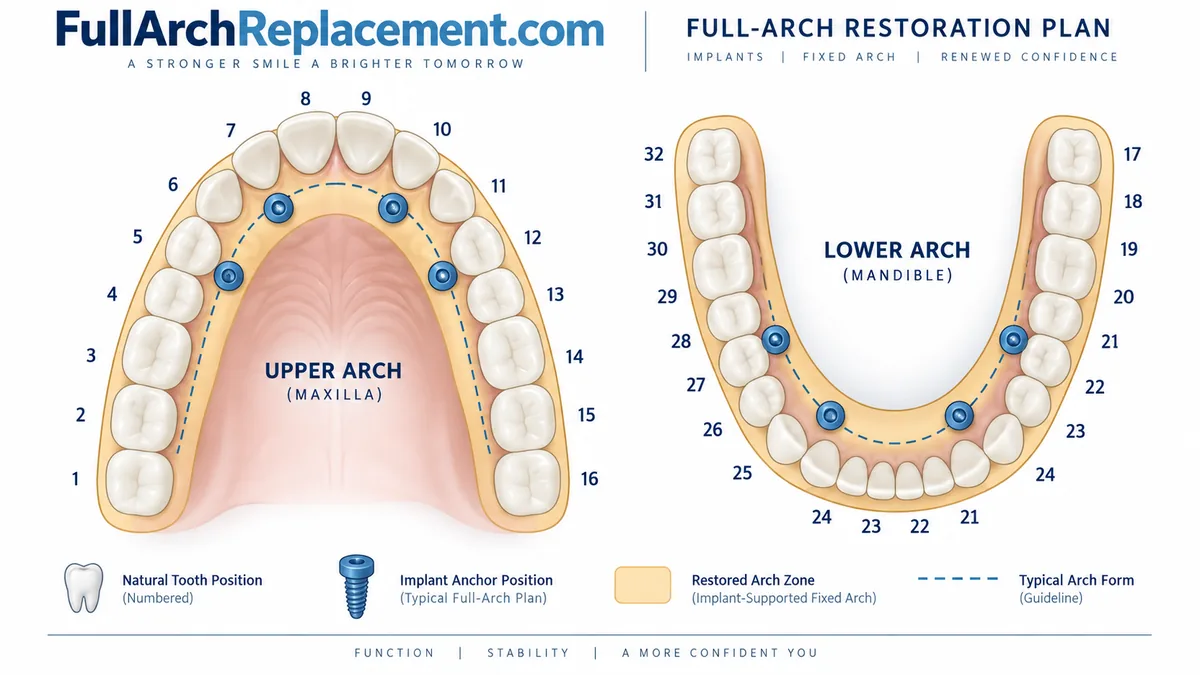
Almost everybody arrives at this question the same way. A clinic quotes All-on-4. A second clinic quotes All-on-6 and it costs three thousand dollars more. Nobody explains why, and the obvious inference — that six is a better version of four — is not quite right.
The number in the name is the number of implants supporting one arch of teeth. That is all it is. Which number is correct for you is decided by your jawbone, not by your budget and not by a package tier on a price sheet.
What the four in All-on-4 is actually doing
The technique places two implants roughly vertically at the front of the jaw, where bone is usually thickest and best preserved, and two at the back tilted at an angle. Tilting is the clever part. It lets the surgeon anchor into denser available bone and place the rear support further back along the arch without running into the sinus in the upper jaw or the nerve canal in the lower one.
The practical consequence is that many people who were told they need bone grafting can skip it. That is not a marketing claim; it is the specific clinical problem the tilted-implant approach was designed to solve.
What adding implants buys you
Two things, mainly.
Load distribution. Bite force spread across six anchor points instead of four means less stress per implant and less flex across the span of the bridge. If you have heavy bite forces, grind your teeth, or are restoring a lower arch that will oppose natural upper teeth rather than another prosthesis, that matters more than it sounds.
Redundancy. This is the argument surgeons tend to make privately. If one implant in a four-implant arch fails, the whole prosthesis is compromised and you are looking at a rescue procedure. In a six-implant arch there is more chance the bridge can be modified and kept in service while the site heals.
Why more is not automatically better
Implants need bone to sit in. Placing six where there is only good bone for four means either grafting first, accepting shorter or narrower implants in compromised sites, or placing anchors in positions that do not actually help the biomechanics. A well-planned four is better than a poorly placed six, every time.
There is also the matter of what a failure costs. More implants means more sites where peri-implantitis can develop, and more hardware to maintain. Six implants is not six times the security; it is a different set of trade-offs.
How the decision actually gets made
From a CBCT scan, and only from a CBCT scan. Your surgeon is looking at bone height, bone width, bone density, where your sinus floor sits, where the inferior alveolar nerve runs, and how your opposing arch will bite against the finished result. None of that is visible in a photograph or a flat panoramic x-ray.
Broad tendencies worth knowing, though your own scan overrules all of them:
- Upper arches more often need extra anchors, because the maxilla is softer bone and the sinuses limit where implants can go.
- Lower arches tolerate four-implant designs well, because the mandible is denser and the front of it is usually well preserved.
- Heavy bite forces or bruxism push toward more implants and a tougher bridge material.
- Severe upper resorption may take you past this question entirely, into zygomatic implants anchored in the cheekbone.
The question to ask your surgeon: “Show me on my scan where you plan to place each implant, and tell me what made you choose that number.” A good answer references your anatomy. A weak answer references a package.
The cost difference, honestly
In the United States, a fixed acrylic-hybrid arch on four implants typically plans at roughly $14,000 to $26,000, with six-implant and zirconia-tier cases commonly running $17,000 to $28,000 and complex reconstructions higher again. Those are 2026 market planning ranges, not quotes, and the gap narrows or widens considerably depending on the bridge material you choose.
Which is the point worth ending on: for most patients, the acrylic-versus-zirconia decision moves the bill more than the four-versus-six decision does. If you are shopping quotes, hold the implant count constant and the material constant, or you are not comparing anything.
Want a second opinion on a quote you already have? Send it over. We read it, tell you what is missing from it, and charge nothing. Message us on WhatsApp or use the contact form.
Keep reading
Next step
Get the plan, then get a second opinion
Ask for your CBCT scan and written treatment plan as files. Show them to one more clinician before you commit. It is the cheapest insurance in this whole process.